

Tools
Figma & Shopify
Mimente Activo
As a Human-Centered Design Consultant for Mimente, an online therapy service based in Mexico, I designed a new service to help them enter the US market. Mimente Activo is a mental health service where coaches guide you through a therapy session while you engage in an exercise of your choice, either remotely or in person.
Role
Design Consultant
Client
Project Type
Human-Centered Design & UX/UI Design
Tools
Figma
Timeframe
12 Weeks


Mimente, an online therapy service based in Mexico, saw an opportunity to provide Latin Americans in the US with therapists who share their language and cultural background. They asked us to design a service that would help them break into the US market.
Background Research
Stigmatized Language
Legal Constraints
Mimente can provide U.S. Telehealth if therapists hold an active California license or associate registration with supervisor approval and follow Telehealth standards. Coaching remains unregulated.
Family Values
Machismo
An Increasing Older Population
Community Interviews
After doing background research on the problem space, we conducted 10 interviews with people who identify as one or more of the following: Latino/a/e, people who use mental health services, and people who work in mental health services.
Hover over each key concept to see an example of some of the quotes that confirmed themes we identified in our literature review.

Language
“In my town, that was called laziness [having symptoms of depression/anxiety].”

Family Values
“Sometimes when I see her like that, I tell her ‘Okay, let’s go!’ I take her with me on a walk…”

Machismo
“My friends will say I'm a pussy if I go (mental health).”
Personas
We created a family of personas after identifying family as central to Latin Culture and attitudes towards mental health. We identified that gender and generation were huge factors in someone’s attitude towards therapy.

Laura is a mother who moved to the US in her late 20s. She speaks English and Spanish, but only speaks the latter in her household. She grew up in a tight-knit community where mental health was never discussed and heavily stigmatized.
Her views on mental health are complex. She is skeptical of therapy; she doesn’t know much about mental health and how it’s perceived in the US. She associates therapy with severe mental distress, and does not know the difference between psychologists and psychiatrists. She is cautious about mental health services prescribing medication for emotional issues, which she is strongly against. Although she has reservations about therapy, she acknowledges its potential benefits for her children and tries to be open to it because she wants the best for her kids.


Early Prototyping
After doing some large scale brainstorming we prototyped a design for each of our personas.
Hover on each prototype to understand how it connects each persona with mental healthcare.
Sherpa Onboarding
For Mother
Mimente Activo
For Son
Find a Therapist
For Daughter

Laura is skeptical of therapy and believes that it is not for her. She would never pay to go to therapy, but could potentially be open to her children seeing one if they really needed it.
By making Mimente’s existing app, Sherpa, free and public, it could act as an entry point for people who are reluctant to the idea of full-on therapy. Rather than giving clients access to Sherpa after they start using Mimente, we believe Mimente should use it as a pathway that leads people to Mimente services. Sherpa acts as a lower-stakes, less intimidating aid for mental health.

Miguel is uncomfortable with the idea of going to therapy but knows he could benefit from talking to someone about his feelings.
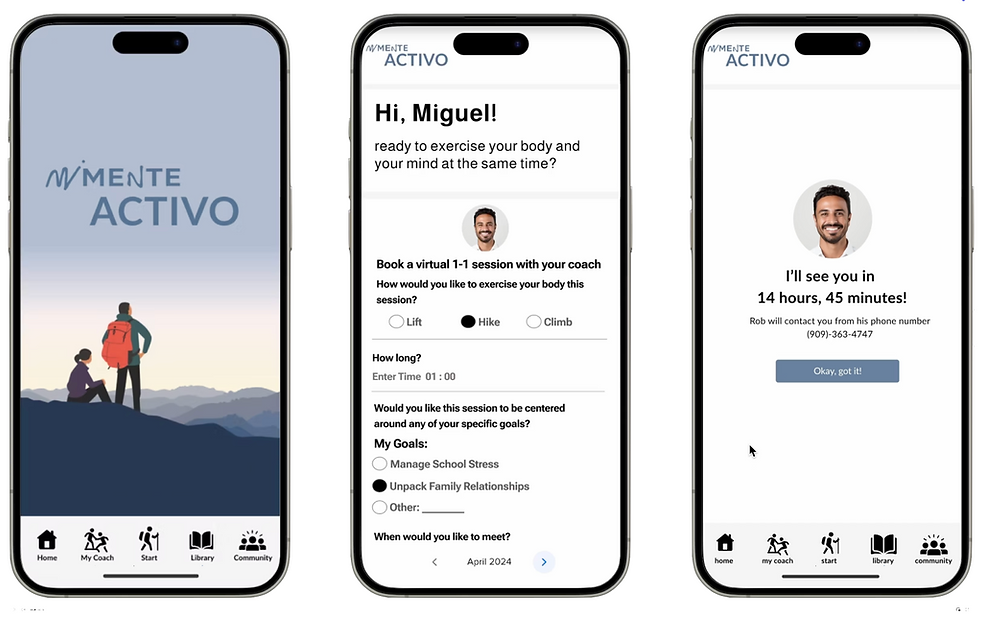
Mimente Activo allows a coach to accompany you while doing a form of exercise of your choosing, while guiding you through a therapy session at the same time! This product attempts to make therapy less intimidating by building on a tool people already use to take care of their health: exercise. It builds on the connection between mind and body that our interviewees expressed as a strong Latine value.
.jpg)
Maria is open to therapy and feels she would benefit from it, but can’t afford the long process it takes to find a therapist.
Inspired by Hinge, a dating app for those who want to seek a serious relationship, this function serves as an easier and less overwhelming way to look at potential therapists. Some therapy-searching websites give you too much information, so with this “Hinge” format, we’re showing an easier way to access and reach out to therapists.
Extreme User
Through our interviews we identified men as our extreme user, they were the least familiar with mental health services and most reluctant to try them. After being asked how they work through their emotions, many men said that physical exercise was a huge outlet to process and work through their issues.
By designing for a user that experiences extreme barriers to mental healthcare we were able to design the most innovative solution, creating a product that considers users at all different levels of comfort with therapy.

So we asked ourselves, how can we rebrand therapy to make it less intimidating for men?

ACTIVO
Mimente Activo attempts to make therapy less foreign and intimidating by building on a tool that lots of people already use to care for their mental and physical health: Exercise! The product also connects the well-being of the mind and body, a strong value within Latin Culture that our interviewees expressed.
Our app facilitates the coach-user interaction and allows users to track both their physical and mental health progress.
Testing and Iteration
We did multiple rounds of testing to reach the final product above.
Hover over each test to see what iteration it led us to.
Coach or Therapist?
Matching With a Therapist
Remote or In-person?
%20(2)_edited_jp.jpg)
We asked 5 people if they preferred the term coach or therapist in the context of this product.
All preferred coaching.
_edited.jpg)
We asked 4 people if they would prefer swiping through therapists or taking a quiz for matches.
All preferred getting matched with 3-5 therapists.
%20(1)_edited_jp.jpg)
In testing, many people assumed this was online. So we asked if they'd prefer this as an in-person or online offering.
People liked the idea of having both options.
More Projects

UI/UX Design & Branding in Urban Design

Programmatic Design, Community Engagement & Human-Centered Design