

Community
Ambassador
For my year-long thesis in Human-Centered Design, I investigated how to improve the lives of older adults living in Pomona, CA. I prototyped the Community Ambassador program, which seeks to empower older adults as stakeholders shaping their community, with an acute understanding of the inequities facing their communities and a uniquely established understanding of the resources within them.
Role
Designer
Project Type
Human-Centered Design & Community Engagement
Timeframe
30 Weeks
Building Reciprocal and Community Care for Older Adults in Pomona


How might we design new models of care that recognize older adults' humanity as people actively shaping their communities?
Theoretical Background
Aging & Care
I first established a strong foundation of the social and cultural issues surrounding aging. This helped me craft my research question.
Cultural Constructions
1. Care Relationships
Through a study of Care Relationships I learned that, care work, which is the labor of sustaining and reproducing human life, is systematically devalued under capitalism, because it falls outside the realm of economically productive activity. This results in care providers that are not culturally recognized for their labor. And as this work is not recognized, it also goes under-supported, often lacking adequate resources.
Whether delivered through kinship, paid home care, or institutional settings, the rigid profit-driven structure of capitalism prevents the kind of holistic, embodied care that recipients truly need. Until society formally recognizes care work as valued labor, both caregivers and those they support will continue to be harmed by this structural neglect.
Intersectional Identities
Increasing Older Population
An Increasing Older Population
Regional Background
Aging in Pomona
After gaining a theoretical foundation, I did some research on aging in Pomona to understand the problem geographically.
California is the state with the most older adults living in poverty
Average Life Expectancy
80.4 years
City of Los Angeles
78.3 years
City of Pomona
Los Angeles, Adults 60+
18% below the poverty line
61% housing cost burdened
19% living alone
By 2024 adults 60+ are projected to make up 30% of Los Angeles County's population
Community Engagement
Community Partners & Interviews
I conducted a community engagement process to ground my designs in the needs and emotions directly expressed by the people I was designing for. Of course, this required some help.
Hover over the images to read more.

The Pomona College Community Engagement Center. They have a strong understanding of the grassroots organizations in Pomona and connected me to Project Horseshoe Farm, a non-profit organization supporting community health. They connected me to older adults living in Pomona for me to interview, and ended up being the organization I proposed my final design to.

I interviewed nine people. Four were older adults living in Pomona. I met three of them at their homes through Project Horseshoe Farm, and one at church. One interviewee was a younger adult living in Pomona. Two were caretakers, one death doula, and one was a doctor. And finally, during my testing phase, I talked to two people with experience relevant to my final design.
Community Profiles
Anonymized Profiles of Interviewies

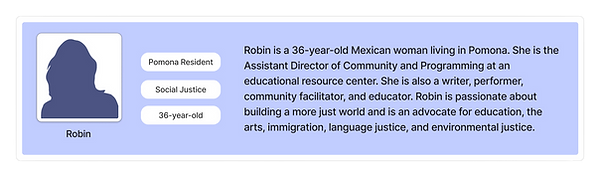
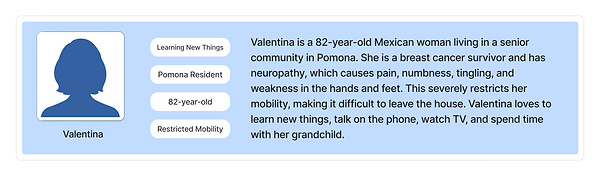


Community Insights from Interviews
Aging: Needs, Barriers, and Opportunities
Hover on the infographic elements to read the insight.

Cultural fear of death emotionally isolates older adults and acts as a barrier to planning for care in old age.

Women’s societal role as primary caretakers acts as a barrier to their own care.

Intergenerational differences are both a barrier and an opportunity for care.

Older adults need resources that stimulate their interests as part of mental health care.

Decrease in in-person services and an increase in automation intensify isolation and act as a barrier to social interaction and autonomy.

Cultural hyperfixation on physical health fails older adults by neglecting the importance of building consistent social connections to support mental health.

Care for older adults needs to offer resources that not only care for the individual but also the individual's space.

Process of Ideation
Brainstorming out of Community Needs, Barriers, & Opportunities
Out of the seven community insights, I chose five to prototype, which led me to four designs that I then took back to interviewees for feedback. There was one prototype that all the interviewees liked, and this was the mini community center. They felt that having resources at a short distance would make a real difference in their lives. Though this idea seemed unrealistic, it was so well liked that I stuck with it and iterated on it to try and make the idea more feasible.
However, over the prototypes to read more about my original ideas.


Testing & Iteration
Iterating on Community feedback
The design evolved through iterative refinement, starting with a "City Block Ambassador" concept: a single point-person every 15 blocks who could support older adults through calls and home visits, requiring only social rather than physical infrastructure. This idea deepened significantly through an interview with Valentina, an older adult who, while giving feedback, revealed herself to already be performing this exact role. Living with limited mobility due to neuropathy, she had built a personal network connecting neighbors and acquaintances to essential resources like food, clothing, and rehabilitation services, while also making sure visitors to her home were always cared for. This revealed that older adults themselves could be the resource, and that the role could meet their own needs for stimulation and social connection while serving the community. This insight led to the Community Ambassador Program, pairing residents 65+ who want to give back with community members in need. The program natural fit within Project Horseshoe Farm, an existing service organization that mentors fellows and interns to support vulnerable individuals. The organization confirmed real demand, with other participants expressing interest in contributing care themselves, and were excited about the prospect of me prototyping the program for them to consider for future implementation. The final iteration added a partner system pairing each Ambassador with a Health Fellow closer to my own age, creating opportunities for intergenerational knowledge exchange and mutual mentorship. This addressed all four original community insights.
Implementation Plan
Co-design
Reese, someone from the community with experience developing an ambassador program, was enthusiastic about the idea and helped me to identify the key questions that would need to be answered. I took these back to Valentina and co-designed the answers with her.
Hover over the question to see the solution.
Reese:
Who will the ambassadors be? Anyone over 65?
This led to my first design decision: That the Community Ambassador will be piloted within Project Horseshoe Farm. And that ambassadors would be Horseshoe Farm community members.

Reese:
Who will use this service, and how will it be promoted?
In line with this, use of the service would be promoted internally to Project Horseshoe Farm community members. If this pilot is successful, the program can expand to the broader Pomona community.
Reese:
What resources will the service connect people to?
We decided Ambassadors would connect community members with subsidized food, clothes, recreational classes, rehabilitation and support services, medical services, and mental health services.
Reese:
How will ambassadors be recognized for their work?
Ambassadors connect people over the phone or in person, when and for as long as they want. A do-not-disturb feature could be implemented, which reroutes calls to a full-time member of the Project Horseshoe Farm team.
Reese:
How will ambassadors be supported?
Iterations could include pay, but we worried that this would deter ambassadors from participating only to their capacity, as they could feel unnecessary pressure, so the program will be piloted as a volunteer position.
Final Design
Community Ambassador Program
The Community Ambassador Program seeks to deconstruct the narratives that invisibilize care work, older age, and interdependence. Creating a structure that recognizes caretakers as community leaders, local knowledge as a valued asset, and reciprocity as foundational to care. By forming clear meaning out of older age, frailty and disability no longer have to act as a threat to personhood, but rather as a transition towards a new phase with new meaning.
Ultimately, this project seeks to examine the flaws in our current system of care to create new methodologies to best support our increasingly older population, and a phase of life that many of us will one day come to experience.


More Projects

Programmatic Design & Community Engagement

Programmatic Design, Community Engagement & Human-Centered Design