

Planning MacArthur Park
With guidance from the founder of KDI, a community development and urban design nonprofit, through a semester-long studio course, I designed for inclusivity and co-existence in MacArthur Park through physical, policy, and programmatic design. I designed Care Hubs which include laundry, bathrooms, storage, and mailboxes; the ID for All Act to reduce address barriers to obtaining documentation; and a rehabilitation resource and vendor fair called Mosaic Market.
Role
Design Researcher
Partner
Project Type
Urban Planning
Tools
Community Engagement
Timeframe
15 Weeks
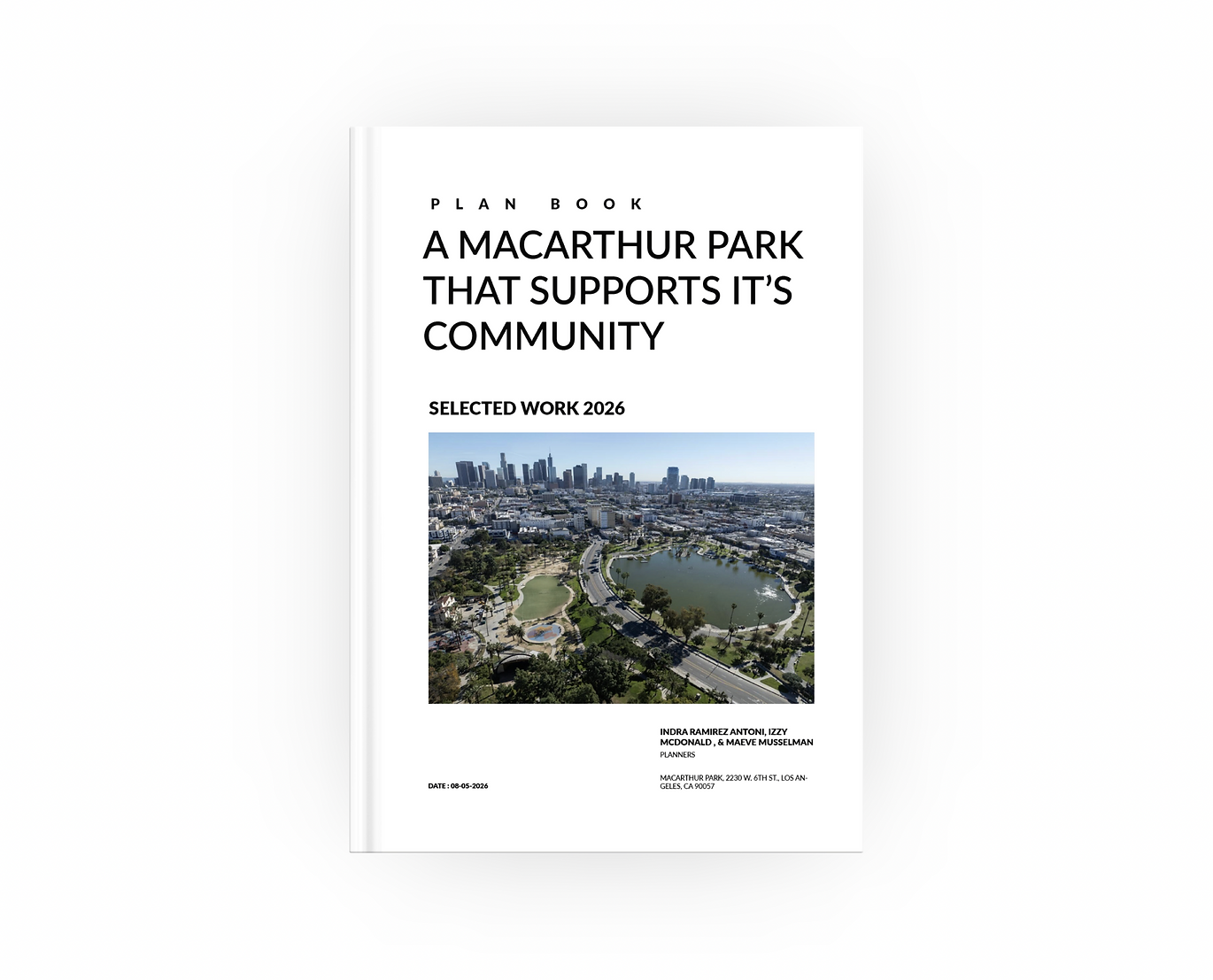
A Plan for Coexistence in MacArthur Park:
Supporting All Through Shared Human Needs
Research
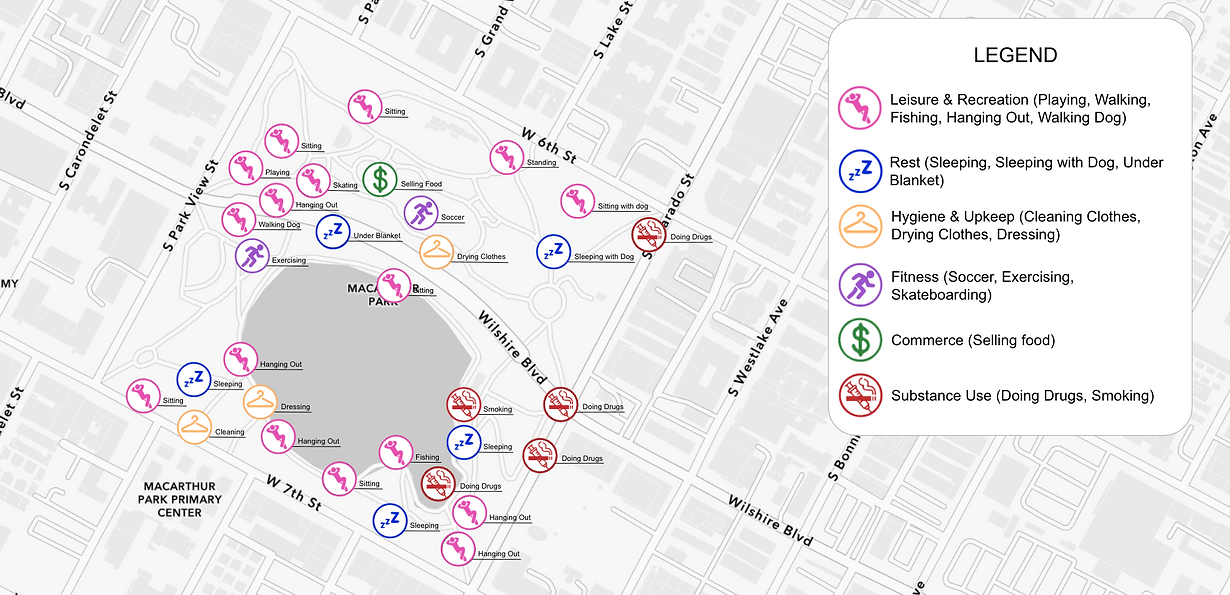
Mapping MacArthur Park Through
an Observation of Behavior
We believe this data can be used to inform what amenities are needed in the park to better support users' activities. The data supports both housed and unhoused people by centering the activity rather than the user.

Plan for Coexistence
Project Goals
Our interventions are built upon each other to provide long-term support. When our basic needs are not met, we do not have the capacity to focus on our long-term goals. For example, if all I can think about is finding a bathroom, I can’t focus on registering for supportive housing. This is why our approach first strives to meet park users’ daily basic needs and then connect them to resources that address long-term needs. This will lead to a more inclusive MacArthur Park because, by centering behavior, we find common ground in the resources we need to support human behavior and meet the needs of housed and unhoused individuals. The goal is to increase empathy for people experiencing houselessness and drug addiction through coexistence and making shared needs visible. We are all human!
Physical Intervention
Design a cluster of “care hubs” scattered through the park to provide all users with bathrooms (showers & toilets), a mail hub, washing machines, and storage to meet immediate basic needs.
Policy Intervention
Now that people’s basic needs are met, use the mail hub to create a permanent address, so that anyone can obtain a California State ID. This removes the barrier of identification to accessing long-term resources such as welfare, social security, veterans’ benefits, and affordable housing.
Programmatic Intervention
Once access to identification is met, increase exposure to resources such as drug rehabilitation, mental health, and housing outreach through a biweekly resource market on Wilshire Boulevard.
Community Engagement
After doing research on the history of Macarthur Park, we wanted to understand the community’s needs, concerns, and visions for the park. To do this, we designed and conducted a community engagement process to hear directly from community residents.
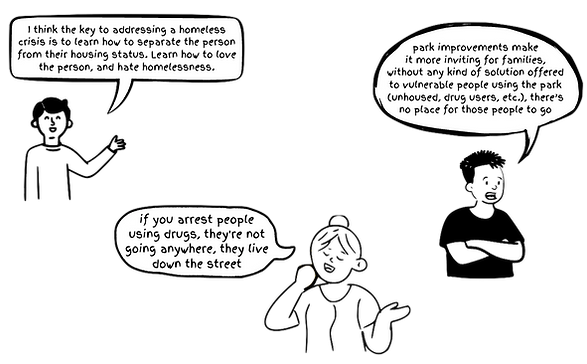
Community Narratives
Opinions from MacArthur Park Peace Ambassadors
Engagement Activity
Lunch at MacArthur Park
The purpose of this activity is to facilitate community building between users of MacArthur Park. This is a workshop where housed and unhoused users of MacArthur Park prepare lunch and sit down together to enjoy the meal they have made. Through this collaborative effort, we hope to plant the seeds of coexistence and co-creation through the goal of a shared objective. Enjoying the meal together is meant to create opportunities for interpersonal connections. We believe this activity works best if repeated. Once repeated a few times, shared meals can become a space to discuss shared needs and desires in the park. Rather than a form of pure data collection, this activity is meant to build a community of MacArthur Park users that can self-advocate for their vision of the park.
Physical Intervention
Care Hubs
Our physical intervention is a cluster of basic need hubs scattered throughout the park to provide users with bathrooms (showers and toilets), a mailroom, washing machines, and storage units. We designed these to be separate amenities that come together rather than clustered in one building for accessibility. Funding would be provided by a public entity, but the hope is that the hubs will be entirely self-sustaining. Our goal is to re-envision MacArthur Park as an epicenter of resources. Since hygiene and storage access are limited for those living in the park, we can improve their quality of life by introducing these simple yet extremely beneficial amenities. They are valuable additions that can serve the entire Westlake community. Each hub will be operated and employed by unhoused people in the park, creating an opportunity for individuals to transition out of homelessness or incarceration. The goal is that unhoused individuals will receive valuable job training by rotating through all of the hubs while also increasing the success of the amenities because they all will be monitored by a “caretaker” of sorts. Two people will be assigned to each location and perform upkeep tasks as needed.


Policy Intervention
The I.D. for All Act
Once basic needs are met, visitors and unhoused users of the park can start thinking about what comes next. Maybe they want to access veterans' benefits they’re eligible for. Maybe they want to apply for a job. Maybe they want to get on a housing waitlist. All of those things require one thing first: an ID. Well, that should be pretty straightforward, right? For over 75,000 unhoused Angelenos, this loop has no exit. So our policy intervention was adapted to break that loop. We propose amending California AB 1733, an existing state law that allows unhoused service providers to issue fee-exempt identification cards. It will certify the MacArthur mail hub as an AB1733-eligible provider, designating its mail hub as an official address of record for DMV purposes. It will also allow the mail hub to assist with fee-exempt birth certificate replacement, the document most commonly needed before an ID can be issued. An ID makes it possible to access welfare checks, social security payments, veterans' benefits, affordable housing, and basic banking. It is an essential tool to connect with resources. This intervention would reduce current barriers that stand between unhoused residents of LA and countless resources. Once someone has an ID, the final barrier is connection: knowing what resources exist and actually being able to access them. We learned through our research that MacArthur Park serves a vital role in LA because unhoused users know that they can get support there.
Closed-Loop Barriers to Basic Needs
State I.D.


Employment Housing
Proof of Address


Permanent Housing
Income Housing
Programmatic Intervention
Mosaic Market
Our programmatic intervention is a bi-weekly, multipurpose resource market that aims to integrate need with enjoyment. We designed the format of the market so that it is appealing and welcoming to a variety of user groups. The goal of the market is to reduce barriers that prevent unhoused people from receiving help by increasing proximity, approachability, and the overall accessibility of resources. Many initiatives tackling visible homelessness in public spaces attempt to separate housed and unhoused people physically. However, we propose cultivating a regular space of interconnection by integrating unhoused people into a space that, in other circumstances, they wouldn’t necessarily be welcomed. It elevates a typical farmer’s market and includes a diversity of services that offer support to unhoused people. Mosaic Market diverges from the traditional approach to developing a community space by actively embracing unhoused people and recognizing the real needs that are occurring in the Westlake neighborhood. We are advocating for the integration of deep-seated issues into vibrant community spaces, allowing for unhoused people’s experiences to finally be seen, heard, and addressed. We also acknowledge that fostering joy and wellness in the lives of unhoused people can act as a lifeboat and perhaps the first step to a way out of homelessness. Simultaneously, we want to respect the wide spectrum of these experiences; unhoused communities like MacArthur’s often develop tight relationships and networks that center around caring for one another, keeping the peace, and maintaining safety. The MacArthur Market will occur from 10 am- 3 pm every other Saturday. It is on a Saturday to draw in people who work weekdays. A variety of public and private organizations will be involved in its implementation. The Vouchers 4 Vendors program held at Mosaic Market will be a partnership with CalFresh and rely on public funding. Modeling the Market Match farmer’s market program, Vouchers 4 Vendors will allow Calfresh recipients to use their EBT cards at local vendor stalls.


This project asks us to rethink what public space is for. When we design around care, shared needs, and accessibility, MacArthur Park can become not a space people are pushed out of, but a space where people are supported in moving forward.
More Projects

UI/UX Design & Branding in Urban Design

Programmatic Design, Community Engagement & Human-Centered Design